Watch Drunken Arts and Crippled Fist Online for Free
| Drunken Master | |
|---|---|
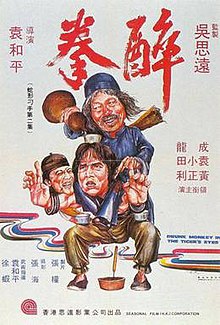 Original Hong Kong movie affiche | |
| Traditional | 醉拳 |
| Cantonese | Zeoi3 Kyun4 |
| Directed by | Yuen Woo-ping |
| Written by | Siao Lung Ng See-yuen |
| Produced by | Ng Run into-yuen |
| Starring | Jackie Chan Yuen Siu-tien Hwang Jang-lee Dean Shek |
| Cinematography | Chang Hui |
| Edited past | Pan Hsiung |
| Music by | Chow Fu-liang |
| Distributed by | Seasonal Film Corporation |
| Release date |
|
| Running time | 110 minutes |
| State | Hong Kong |
| Linguistic communication | Cantonese |
| Box role | Usa$sixteen.5 million (est.) |
Drunken Primary (Chinese: 醉拳; lit. 'drunken fist') is a 1978 Hong Kong martial arts one-act film directed by Yuen Woo-ping, and starring Jackie Chan, Yuen Siu-tien, and Hwang Jang-lee.[1] It was a success at the Hong Kong box role, earning 2 and a half times the amount of Yuen's and Chan'due south previous motion picture, Snake in the Hawkeye's Shadow, which was too considered a hitting.[two] [iii]
It is an early milestone of the kung fu comedy genre, and helped brand Jackie Chan famous in Asia. The movie popularised the Zui Quan ("drunken fist") infused with unique creature fighting manner. In 2017, information technology was ranked number iii on GamesRadar'due south list of 50 greatest kung fu movies of all time.[4] It spawned an official sequel, Drunken Chief II (1994), and several spin-offs. Information technology had a meaning cultural impact, inspiring numerous subsequently films, music, manga, anime and video games.
Background
The flick's protagonist Wong Fei-hung was a Chinese martial artist, a traditional Chinese medicine practitioner and a revolutionary who lived towards the end of the Qing Dynasty. He became a Chinese folk hero and the subject of several Hong Kong television programmes and films. Beggar Then, who plays a supporting role in the film, is also another graphic symbol from Chinese folklore and ane of the Ten Tigers of Canton. The Beggar So grapheme is often cast as an associate of Wong Fei-hung or Wong's uncle.
Plot
The plot centers on a young and mischievous Wong Fei-hung (sometimes dubbed as "Freddie Wong"). Wong runs into a serial of troubles. Firstly, he teaches an overbearing banana martial arts teacher a lesson. Adjacent, he makes advances on a woman to impress his friends, and is soundly thrashed by her older female guardian as a result; his shame is compounded when these two are later on revealed to be his visiting aunt and cousin, whom he had not met before. Lastly, he beats up a hooligan who turns out to exist the son of an influential homo in town. His father decides to punish him for his beliefs by making him railroad train harder in martial arts.
Wong's male parent arranges for Ragamuffin So to train his son in martial arts. Beggar So has a reputation for crippling his students during training and so Wong flees from home in an attempt to escape his punishment. Penniless, he stops at a eating house and tries to con a fellow patron into offer him a costless meal. Every bit he was about to leave after his meal, he discovers that the human is actually the owner of the restaurant. He fights with the possessor's lackeys in an attempt to escape. An one-time drunkard nearby is drawn into the fight and helps him escape. The drunkard turns out to be Beggar And so, the Drunken Master. (Beggar So is known in some versions of the film as Sam Seed, So Hi or Su Hua-chi)
Beggar Then forces Wong into his brutal and rigorous training programme. Wong flees over again to avoid the torturous preparation and runs into the notorious killer Yim Tit-sam (known in some versions as Thunderfoot or Thunderleg) past accident. Yim is known for his "Devil's Kick", a swift and mortiferous kicking style which has never been defeated. Wong provokes and challenges him to a fight and is soundly defeated and humiliated. He makes his way back to Ragamuffin And so and decides to commit himself to the Drunken Master's training plan.
The preparation resumes and soon Wong learns Ragamuffin And so's surreptitious style of martial arts, a form of Drunken Boxing called "The Viii Drunken Immortals", named afterwards the eight xian that the fighting fashion references. Wong masters seven of the 8 styles with the exception of Drunken Miss Ho'due south as he feels that her style of fighting is too feminine.
Meanwhile, Yim Tit-sam is contracted by a business rival to impale Wong's begetter. Wong'south father fights with Yim and is defeated and injured past him. Wong and Beggar So go far on the scene on time and Wong continues the fight with Yim. Beggar Then promises not to interfere in the fight. Wong employs the new skills he has learned and outmatches Yim'south kicking fashion. Yim then resorts to his secret technique, the Devil's Shadowless Hand, which is too fast for Wong to defeat. Wong confesses that he did non master the concluding manner so Beggar So tells him to combine the vii styles and create his own version of the terminal style. Wong follows the instruction and discovers his ain unique style of Drunken Miss Ho, which he uses to overcome the Shadowless Paw and finally defeat Yim.
Cast
- Jackie Chan as Wong Fei-hung / Freddy Wong (UK version)
- Yuen Siu-Tin can (or Simon Yuen) as Ragamuffin So / Sam Seed
- Hwang Jang-lee as Thunderleg Yen Tie Hsin / Thunderfoot
- Dean Shek equally Professor Kai-Hsin
- Lam Kau as Wong Kei-Ying / Robert Wong (UK version)
- Fung King-man as Mr. Lee Human-ho
- Hsu Hsia every bit Rex of Bamboo Hsu Ching-tien
- Linda Lin as Wong Fei-hung's aunt
- Yuen Shun-yi as Chan Kwok-wai / Charlie Wei
- Tong Jing as Wong Fei-hung's cousin
- Tino Wong as Jerry Lee
- Yuen Woo-Ping equally Human with bucket of greens
Fight scenes and martial arts
A number of notable fights are featured in the film, almost all of them with strong elements of comedy—from the game of Keep Abroad with Wong Kei-ying's cocky, only incompetent, assistant kung fu instructor, to the novel "head-fu" fighting style used by one of his opponents. The film features the Hung Ga system of fighting, which was historically practiced past Wong Fei-hung and his father Wong Kei-ying, both of whom are major characters in the film. The animal styles of Snake, Crane, and Tiger performed in the film are derived wholly from the Hung Ga system and bear only a tangential relationship to the Fujian White Crane, Lama Pai (Tibetan White Crane), Black Tiger, and Snake systems of kung fu. Monkey style kung fu, pop in Southern Chinese martial arts performances, is too shown briefly.
Numerous systems of kung fu include "Drunken Boxing" forms (e.grand. Choi Lei Fut and Drunken Monkey), and the Taoist Eight Immortals are pop staples of Chinese civilisation and art. Nonetheless, the "Viii Drunken Immortals" forms depicted in this film are likely the creation of manager and choreographer Yuen Woo-ping and based on routines establish in other systems.
The primary villain in Drunken Master is played by Hwang Jang-lee, a Korean martial artist specialising in Taekwondo and known for his loftier-flight kicks, which are prominently displayed in the film. The systems of "Devil'due south Kicking" and "Devil's Shadowless Hands" employed past Thunderleg are entirely fictitious.
According to his book I Am Jackie Chan: My Life in Action, Chan most lost an eye after his brow ridge was injured.[v] [six]
Theme song
The theme song of Drunken Master is based on a Chinese folk song, "Under the General'south Orders". Since Drunken Master, the theme song has been popularly associated with the folk hero Wong Fei-hung, who Jackie Chan plays in the pic. It was later used in the 1983 film Winners and Sinners, starring Sammo Hung; it was played in a marketplace scene whilst the Five Lucky Stars are watching two men demonstrating the beneficial furnishings of their medicines and their martial arts stances, in reference to Wong Fei-hung. "Under the General's Orders" later get the main theme vocal for the Once Upon a Time in China series starring Jet Li, who besides plays Wong Fei-hung.
Box role
At the Hong Kong box office, Drunken Master earned an impressive HK$vi,763,793[2] (The states$1,445,255).[7] Information technology was the second most popular film in Hong Kong in 1978 behind the Hui brothers' The Contract and third on the best list.[8] [9]
In Japan, where it released on 21 July 1979, it became 1 of the yr's height ten highest-grossing films, earning ¥one.9 billion [10] (US$8.7 million).[11] In South korea, information technology was the highest-grossing movie of 1979, with 898,561 box admissions in Seoul Urban center,[12] equivalent to an estimated ₩1,347,842,000[13] (United states$2,784,800).[14] The film too broke records in Malaysia and Singapore.[8]
In Germany, where information technology was released as Sie nannten ihn Knochenbrecher ("They Called Him Bone Billow") on 25 July 1980, it was the 41st highest-grossing flick of the year, selling 584,312 tickets,[15] equivalent to an estimated €1,460,780[16] (US$two,063,606).[17] In Spain, the film sold 823,203 tickets,[18] equivalent to an estimated €1,070,164[sixteen] (US$1,489,989).
Combined, the flick grossed an estimated total of approximately U.s.$16,483,650 (equivalent to $68,000,000 in 2021) in East Asia and Europe.
Sequels and spinoffs
- Drunken Primary II (1994) stars Jackie Chan, and is considered the only official sequel. Chan portrays the same character, Wong Fei-hung. The US release of the moving picture in 2000 was entitled The Legend of Drunken Master.
- In 1979, Yuen Siu-Tin reprised the function of Ragamuffin So in the film Trip the light fantastic toe of the Drunkard Mantis, which is entitled Drunken Master Part 2 (non to be confused with Drunken Master II noted higher up) in some releases. The film, which was again directed past his son, Yuen Woo-Ping, does not characteristic Jackie Chan, focusing instead on the drunken beggar character rather than on Wong Fei-hung. It is therefore mostly considered to exist a spinoff rather than a true sequel.
- Yuen played this aforementioned role again in the films Story of Drunken Master and World of the Drunken Primary.
- In 2010 Yuen Woo-ping returned to directing with True Fable, which could exist called a prequel to Drunken Master equally information technology explains why Beggar Su (played by Vincent Zhao) turns to drinking.
Imitators
As with several successful Hong Kong activity films, a number of films were released in the wake of Drunken Master (and its sequel) that could exist considered to trade on the fame of the original films. These had less in common with the original films than the spinoffs starring Yuen Siu-tien. They include:
- 5 Superfighters (aka The Drunken Fighter) (1978)
- Drunken Swordsman (aka Drunken Dragon Strikes Dorsum) (1979)
- Drunken Arts and Crippled Fist (Featuring Li Yi Min) (1979)
- Drunken Principal, Slippery Snake (Starring Cliff Lok) (1979)
- Shaolin Drunken Monkey (Starring Elton Chong) (1981)
- The Shaolin Drunken Monk (starring Gordon Liu) (1982)
- Drunken Tai Chi (directed by Yuen Woo-ping and starring Donnie Yen) (1984)
- Revenge of the Drunken Master (1984), starring Johnny Chan,[19] whose proper noun allowed him to trade off his more successful namesake in other low-budget martial arts films including Golden Dragon, Silver Serpent (1979) and The Eagles Killer (1978)
- Drunken Master 3 (aka Drunken Chief Killer) – starring Andy Lau (1994)
- The Niggling Drunken Masters (1995)
Not all films that feature the Zui Quan "Drunken Fist" mode (or variations on information technology) can be considered as imitators of the Drunken Master films. Films such every bit Drunken Monkey (2002) may characteristic a drunken style of kung fu, and in the case of The Forbidden Kingdom (2008), the same master star, but they have a fundamentally unlike plot and sufficiently different title to separate them from Drunken Master.
Dwelling house media
- On 24 Apr 2000, Hong Kong Legends released a DVD in the Great britain. The image is cropped from 2:35:1 to i:78:i and has the Standard mandarin soundtrack with dubtitles. However, information technology has a number of additional features including a deleted scene and an interview with producer Ng See-yuen.
- On ii Apr 2002, Columbia Pictures released a DVD in the United States. Despite a 2:35:1 image and the inclusion of the original Cantonese rail, the sound is incomplete in some sections (reverting to the English language dub) and contains dubtitles. There's an sound commentary by Ric Meyers and Jeff Yang.[xx]
- On eighteen March 2004, HKVideo released a "Wong Fei Hung" DVD boxset in French republic containing this film (French title: "Le maître chinois") and 2 others. It contains a full 2:35:1 image and the Cantonese soundtrack. However, it contains slightly poorer epitome quality and no English subtitles.
- On 30 April 2004, Mei Ah Amusement released a remastered DVD in Hong Kong (pictured right). Information technology contains a 2:35:1 epitome, Cantonese Dolby Digital 5.ane track, original Cantonese Dolby Digital 2.0 mono track and Mandarin Dolby Digital 2.0 mono track. Subtitles include Traditional Chinese, Simplified Chinese and English language. The missing Cantonese for the opening has been re-dubbed in Cantonese and the other missing Cantonese scenes as extended footage in Mandarin due to trouble of re-dubbing with new vocalism actors. Many short lines missing Cantonese had been removed. Special features include Extended footage, accessed during the film by selecting the vino jug icon when it appears on the right top corner, Mastering the Drunken Main, a 35-second music video with clips of Jackie Chan practicing the 8 Drunken Gods from the film, motion-picture show synopsis and cast & crew.
- PanMedia released a bootleg DVD that contains the consummate Cantonese track.
Cultural bear upon
Fashion
- During the late 1970s to early 1980s, Jackie Chan's shoulder-length hairstyle in Drunken Principal became popular across Asia, widely adopted by both men and women across the region.[21]
Motion-picture show
- Edgar Wright's The World's Stop (2013) had drunken pub fight scenes inspired by Drunken Chief. The film'due south fight scenes were choregraphed past Brad Allan, who was office of the Jackie Chan Stunt Team during the 1990s to 2000s.[22]
Manga and anime
- Manga author Akira Toriyama cited Drunken Chief equally one of his major inspirations for the Dragon Ball serial of shōnen manga and anime, forth with Bruce Lee'south Enter the Dragon (1973) and the Chinese novel Journey to the West.[23] Toriyama said that he would never take come up upward with Dragon Ball if he had not watched Drunken Master,[24] and he was drawn to its more low-cal-hearted tone.[25] Drunken Master as well served every bit a reference for the preparation scenes.[26] The series pays homage to Drunken Principal when the first tournament is held, where Kame-Sennin (Master Roshi) is disguised as "Jackie Chun" and he tries to utilize a Drunken Fist technique on Son Goku (Goku).
- In the Naruto series, ane of the characters 'Rock Lee' is seen performing similar fighting styles after consuming alcohol. Known every bit the 'Drunken Fist' in the series' Japanese version and the 'Loopy Fist' in the English.
Music
- Jamaican musicians Sly Dunbar, Robbie Shakespeare, and The Revolutionaries recorded a reggae song chosen Drunken Master which was released in 1981 past Island on an anthology chosen Sly and Robbie Present Taxi.[27]
- UK dubstep artist FuntCase used spoken communication samples taken from the film in his vocal "One-half drunkard".
- The hip-hop creative person Hona Costello used the championship and the starring histrion'southward name Jackie Chan for his song, "Drunken Master".
Video games
- The PlayStation game Jackie Chan Stuntmaster includes a bonus level in which he wears his traditional Drunken Master dress and drinks vino while fighting. He even gives the Drunken Punch equally his charge dial throughout the game.
- In popular PC online game Guild Wars, at that place is a stance-skill called "Drunken Master" which temporarily increases motility and assault speed. This effect is doubled if character is drunk.
- In The Male monarch of Fighters serial, the character Mentum Gentsai was modeled after Su Hua Chi.
- The Tekken video game serial features a grapheme named Lei Wu Long, a Hong Kong detective based on Jackie Chan'due south Police Story films. While the character was originally nicknamed Supercop later the picture Police Story 3: Supercop Lei Wu Long uses 5 to six+ stances which have all of Jackie Chan's signature film movies. Initially in the series it focused on the Snake manner he created for Ophidian in The Eagles Shadow. In Street Fighter X Tekken released in 2012, Lei Wulong's "Ultimate Stance" is "Drunken Fist" based on his performance in the 1978 original and the 1994 sequel.
- The Dead or Live video game franchise features a playable grapheme named Brad Wong; a drunken wanderer introduced in Dead or Alive 3 who specializes in the zui quan fighting fashion, and was taught by a non-playable character named Chen.
- The Mortal Kombat video game franchise introduced Bo' Rai Cho in Mortal Kombat: Deadly Alliance; his proper noun is a play on the word "borracho" (Spanish for "boozer"), and he is indeed usually depicted as intoxicated, and conveying a canister of alcohol. His fighting moves consist of drunken style fighting mixed with vulgar actions.
See as well
- Jackie Chan filmography
- List of Hong Kong films
- List of martial arts films
References
- ^ "Drunken Main (1978)". hkmdb.com . Retrieved 25 April 2018.
- ^ a b "HKMDb entry". Drunken Principal (1978) . Retrieved 17 April 2008.
- ^ "HKMDb entry". Serpent in the Eagle'due south Shadow (1978) . Retrieved 17 April 2008.
- ^ "The 25 best kung fu movies y'all take to see". GamesRadar. xi April 2017. Retrieved 11 April 2017.
- ^ Jackie Chan. "Jackie's Aches and Pains: It Only Hurts When I'grand Not Laughing". Random House. Retrieved 19 Dec 2012.
- ^ Chan, Jackie (1999). I Am Jackie Chan: My Life in Activity. Ballantine Books. ISBN9780613217385.
- ^ "Official exchange rate (LCU per US$, period average)". Globe Depository financial institution. 1978. Retrieved 21 November 2018.
- ^ a b "More than than 'the next Bruce Lee'". Variety. 23 Jan 1995. p. 56.
- ^ "Hong Kong's xx Alltime Top Pix". Diversity. iii Jan 1979. p. 42.
- ^ "【ジャッキーチェン興行成績】 第12回:日本での興行収入". KungFu Tube (in Japanese). Retrieved 21 November 2018.
- ^ "Official exchange charge per unit (LCU per US$, period average) - Nihon". World Bank. 1979. Retrieved 21 June 2020.
- ^ "【ジャッキーチェン興行成績】 第10回:韓国での興行収入". KungFu Tube (in Japanese). 5 September 2010. Retrieved 7 December 2018.
- ^ "Asian Culture Quarterly". Asian Civilisation Quarterly. Asian Cultural Middle. 11–12: 20. 1983.
The average admission fee in 1979 was 1,000 won for national films and 1,500 won for imports. (In 1982, the average increased to 2,000 won, or Usa$three.)
- ^ "Official exchange rate (KRW per US$, period average)". World Bank. 1979. Retrieved 7 December 2018.
- ^ "Dice erfolgreichsten Filme in Deutschland 1980" [The Most Successful Films in Germany (1980)]. Within Kino (in German language). 1980. Retrieved 22 June 2020.
- ^ a b "Movie house market". Cinema, Idiot box and radio in the EU: Statistics on audiovisual services (Information 1980-2002). Europa (2003 ed.). Office for Official Publications of the European Communities. 2003. pp. 31–64 (61). ISBN92-894-5709-0. ISSN 1725-4515. Retrieved 23 May 2020.
- ^ "Historical currency converter (EUR)". fxtop.com. 25 July 1980. Retrieved 2 June 2020.
- ^ Soyer, Renaud (4 February 2014). "Jackie Chan Box Function". Box Office Story (in French). Retrieved i July 2020.
- ^ "Johnny Chan (I)". IMDb.com . Retrieved 15 September 2016.
- ^ "Drunken Master : DVD Talk Review of the DVD Video". Dvdtalk.com . Retrieved 15 September 2016.
- ^ "Jackie Chan Headed For Bruce Lee-Type Stardom With New Pic". Indiana Gazette. 9 October 1980. Retrieved 8 April 2022 – via NewspaperArchive.
The 1978 "Boozer Monkey in a Tiger'south Middle" made him an instant star. His shoulder-length hair was copied past both males and females all over Asia.
- ^ Franklin, Oliver (17 July 2013). "Edgar Wright interview on The World'due south End, pubs & Ant Man – Film – GQ.COM (United kingdom)". Gq-mag.co.uk. Archived from the original on 21 July 2013. Retrieved 22 July 2013.
- ^ The Dragon Brawl Z Legend: The Quest Continues . DH Publishing Inc. 2004. p. 7. ISBN9780972312493.
- ^ "Interview — Dragon Power / Enquire Akira Toriyama!". Shonen Jump (ane). January 2003.
- ^ "Akira Toriyama on the Route". Dragon Ball Kanzenban Kōshiki Guide: Dragon Ball Landmark. Tōkyō: Shūeisha. nineteen Dec 2003. ISBNiv-08-873478-5.
- ^ "The Truth About the "Dragon Ball" Manga: "Toriyama Idea of It Like This" Special". Dragon Ball Super Heady Guide: Story-Hen (DRAGON BALL 超エキサイティングガイド ストーリー編) [Dragon Brawl Super Exciting Guide: Story Book]. Tōkyō: Shūeisha. iv March 2009. ISBN978-4088748030.
- ^ "Sly & Robbie". Reggae Reviews. Archived from the original on 11 September 2012.
External links
- Drunken Master at IMDb
- Drunken Master on HKMDB
- Drunken Master at Rotten Tomatoes
- Drunken Chief at Box Role Mojo
- Drunken Master at AllMovie
- Hong Kong Fanatics: Jackie Chan
mikesellwitheitay.blogspot.com
Source: https://en.wikipedia.org/wiki/Drunken_Master
0 Response to "Watch Drunken Arts and Crippled Fist Online for Free"
Postar um comentário